All cancer clinical trials follow a stringent, highly regulated process to ensure that potential benefits outweight any risks.
Clinical trials testing treatments are conducted in a series of phases to assess safety, determine appropriate dosing, and evaluate how well the treatment works.
Before clinical trials begin
Before any treatment is tested in people, researchers spend many years developing and testing it in the laboratory. This is known as the preclinical phase.
If early results suggest the treatment may be safe and effective, it can progress to clinical trials involving human participants.
Phases of clinical trials for new treatments
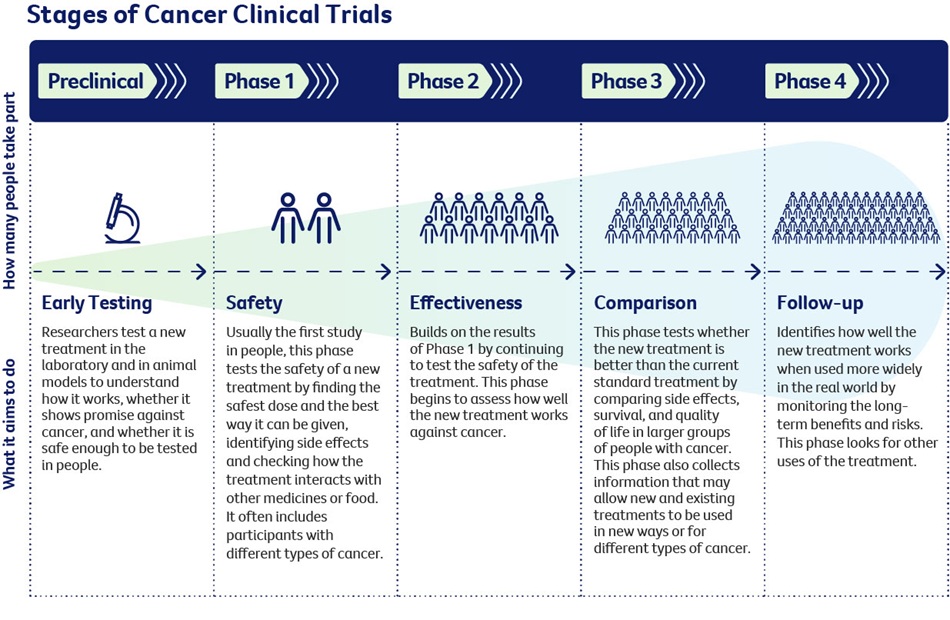
Clinical trials are conducted in phases, with each stage building on the evidence gathered previously.
- Phase I trials test the safety, and determine the safest dose and the best way it can be given
- Phase II trials continue to test safety while exploring how well the treatment works
- Phase III trials compare the new treatment with the current standard treatment
- Phase IV trials tend to occur after the treatment has been approved, and monitor long-term safety and effectiveness
The phase of a clinical trial reflects how much is known about a treatment overall. It does not predict how well an individual may respond or whether it is the best option for them.
Importantly, clinical trial phases do not indicate how "good" a treatment is - early phases (Phase I and II) focus on safety rather than comparison.
Clinical trial phases may overlap, be combined (for example, Phase I/II studies), or use adaptive designs. This means they do not always follow a strictly sequential pathway.
At every phase, researchers assess whether the potential benefits outweigh the risks. Findings from each phase determine whether the trial can move forward and, ultimately, whether the treatment may be approved for public use and become standard practice. As a result, evidence on safety and effectiveness accumulates over time.
Why some clinical trials don't have phases
Not all cancer clinical trials use phases. Phases are mainly used for studies testing new treatments where researchers need to understand safety, dosing, and how well the treatment works before it can be approved.
Other types of studies, like those looking at screening, diagnosis, supportive care, or quality of life, may not follow the same phased process. These may be described as 'no phase' or 'not applicable.'
Learn more about the different types of trials.
Role of ethics and safety monitoring
Cancer clinical trials are reviewed and overseen by a Human Research Ethics Committee (HREC) to ensure they are conducted ethically and that participants' rights, safety, and wellbeing are protected. Before a trial can begin, the HREC must approve the study design, and this oversight continues throughout the trial.
As a study progresses, emerging data is carefully reviewed. Trials may be modified or stopped early if:
- there are safety concerns,
- if the treatment is found to be ineffective, or
- if strong benefits become evident sooner than expected.
This continuous review process helps ensure that clinical trials remain safe, scientifically valid, and aligned with the best interests of participants.